Published by Dimitris Kougioumtzis · Updated
Build prefix LCS lengths, then backtrack to reconstruct one longest common subsequence.
Matching final prefix characters extend an inner solution; otherwise discard one final character from either prefix.
When to use Longest common subsequence
Order-preserving similarity and basic diff construction.
Choosing an alternative
Common substring requires contiguity; edit distance assigns edit costs.
Worked example: input and state changes
Example input
ABCBDAB | BDCABAThese checkpoints follow the actual example timeline. State details show the stored values and decisions; use the visualization to inspect every intervening step.
Step 0: Base row and column are zero.
State at this checkpoint
{
  "values": [
    0,
    0,
    0,
    0,
    0,
    0,
    0,
    0,
    0,
    0,
    0,
    0,
    0,
    0,
    0,
    0,
    0,
    0,
    0,
    0,
    0,
    0,
    0,
    0,
    0,
    0,
    0,
    0,
    0,
    0,
    0,
    0,
    0,
    0,
    0,
    0,
    0,
    0,
    0,
    0,
    0,
    0,
    0,
    0,
    0,
    0,
    0,
    0,
    0,
    0,
    0,
    0,
    0,
    0,
    0,
    0
  ],
  "active": [],
  "kind": "matrix",
  "columns": 7,
  "rowLabels": [
    "∅",
    "A",
    "B",
    "C",
    "B",
    "D",
    "A",
    "B"
  ],
  "columnLabels": [
    "∅",
    "B",
    "D",
    "C",
    "A",
    "B",
    "A"
  ]
}
Step 13: Compare C and B; LCS length for these prefixes is 1.
State at this checkpoint
{
  "values": [
    0,
    0,
    0,
    0,
    0,
    0,
    0,
    0,
    0,
    0,
    0,
    1,
    1,
    1,
    0,
    1,
    1,
    1,
    1,
    2,
    2,
    0,
    1,
    0,
    0,
    0,
    0,
    0,
    0,
    0,
    0,
    0,
    0,
    0,
    0,
    0,
    0,
    0,
    0,
    0,
    0,
    0,
    0,
    0,
    0,
    0,
    0,
    0,
    0,
    0,
    0,
    0,
    0,
    0,
    0,
    0
  ],
  "active": [
    22
  ],
  "kind": "matrix",
  "columns": 7,
  "rowLabels": [
    "∅",
    "A",
    "B",
    "C",
    "B",
    "D",
    "A",
    "B"
  ],
  "columnLabels": [
    "∅",
    "B",
    "D",
    "C",
    "A",
    "B",
    "A"
  ]
}
Step 26: Compare D and D; LCS length for these prefixes is 2.
State at this checkpoint
{
  "values": [
    0,
    0,
    0,
    0,
    0,
    0,
    0,
    0,
    0,
    0,
    0,
    1,
    1,
    1,
    0,
    1,
    1,
    1,
    1,
    2,
    2,
    0,
    1,
    1,
    2,
    2,
    2,
    2,
    0,
    1,
    1,
    2,
    2,
    3,
    3,
    0,
    1,
    2,
    0,
    0,
    0,
    0,
    0,
    0,
    0,
    0,
    0,
    0,
    0,
    0,
    0,
    0,
    0,
    0,
    0,
    0
  ],
  "active": [
    37
  ],
  "kind": "matrix",
  "columns": 7,
  "rowLabels": [
    "∅",
    "A",
    "B",
    "C",
    "B",
    "D",
    "A",
    "B"
  ],
  "columnLabels": [
    "∅",
    "B",
    "D",
    "C",
    "A",
    "B",
    "A"
  ]
}
Step 38: Compare B and D; LCS length for these prefixes is 2.
State at this checkpoint
{
  "values": [
    0,
    0,
    0,
    0,
    0,
    0,
    0,
    0,
    0,
    0,
    0,
    1,
    1,
    1,
    0,
    1,
    1,
    1,
    1,
    2,
    2,
    0,
    1,
    1,
    2,
    2,
    2,
    2,
    0,
    1,
    1,
    2,
    2,
    3,
    3,
    0,
    1,
    2,
    2,
    2,
    3,
    3,
    0,
    1,
    2,
    2,
    3,
    3,
    4,
    0,
    1,
    2,
    0,
    0,
    0,
    0
  ],
  "active": [
    51
  ],
  "kind": "matrix",
  "columns": 7,
  "rowLabels": [
    "∅",
    "A",
    "B",
    "C",
    "B",
    "D",
    "A",
    "B"
  ],
  "columnLabels": [
    "∅",
    "B",
    "D",
    "C",
    "A",
    "B",
    "A"
  ]
}
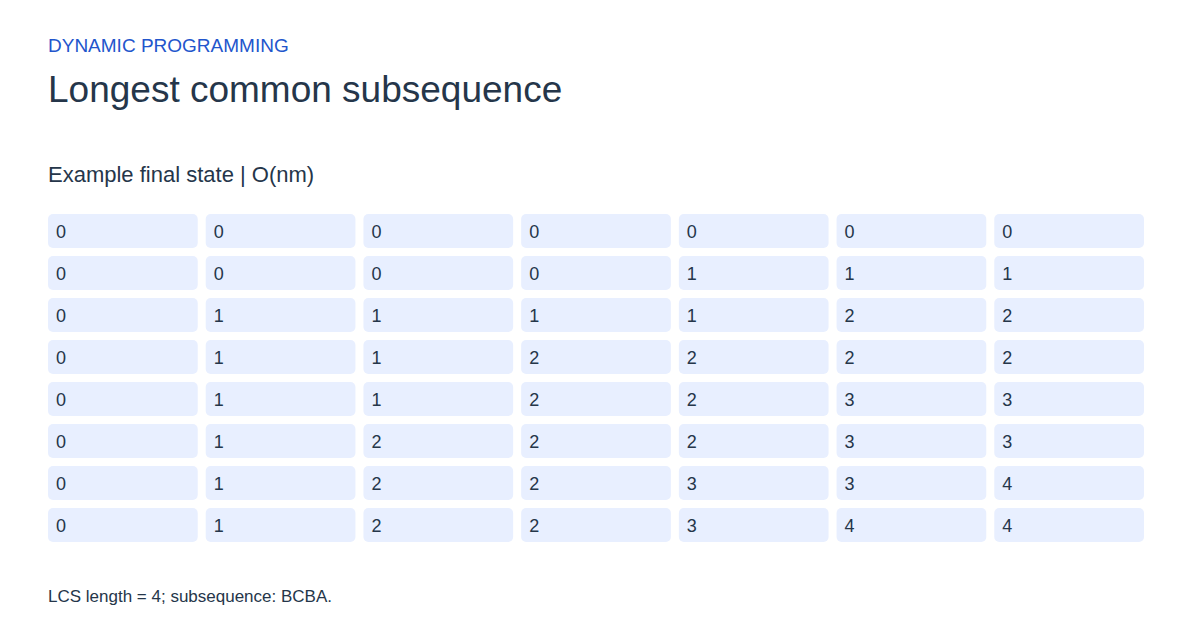
Step 51: LCS length = 4; subsequence: BCBA.
State at this checkpoint
{
  "values": [
    0,
    0,
    0,
    0,
    0,
    0,
    0,
    0,
    0,
    0,
    0,
    1,
    1,
    1,
    0,
    1,
    1,
    1,
    1,
    2,
    2,
    0,
    1,
    1,
    2,
    2,
    2,
    2,
    0,
    1,
    1,
    2,
    2,
    3,
    3,
    0,
    1,
    2,
    2,
    2,
    3,
    3,
    0,
    1,
    2,
    2,
    3,
    3,
    4,
    0,
    1,
    2,
    2,
    3,
    4,
    4
  ],
  "active": [],
  "kind": "matrix",
  "columns": 7,
  "rowLabels": [
    "∅",
    "A",
    "B",
    "C",
    "B",
    "D",
    "A",
    "B"
  ],
  "columnLabels": [
    "∅",
    "B",
    "D",
    "C",
    "A",
    "B",
    "A"
  ],
  "subsequence": "BCBA"
}
Expected final state
LCS length = 4; subsequence: BCBA.
Complexity and input bounds
Family: Dynamic programming. Time complexity: O(nm).
Space complexity: O(nm) reconstruction table.
Working-space bounds describe algorithm state and any explicitly noted output, excluding the visualization's saved timeline. Recording frames can use more memory than running the function alone. Here n is sequence length, V and E are vertex and edge counts, and other parameters refer to the named input dimensions.
First string | second string; up to 12 letters each, including empty strings.
The playground validates these limits before starting. Downloaded functions are callable implementations, with parameter and output-buffer contracts in their comments; they do not all repeat the playground's input validation.
Common mistakes and limitations
Subsequences may skip characters and ties can produce several valid reconstructions.
Further reading
For background on algorithm analysis and the JavaScript function interface:
- MIT OpenCourseWare: algorithm design and analysis foundations
- MDN: JavaScript function parameters and return values
Editorial and testing approach · Browse all algorithm guides
Complete JavaScript implementation
1 2 3 4 5 6 7 8 9 10 11 12 13 14 15 16 17 18 | // first and second are ASCII character-code arrays, each length ≤ 12. Writes one longest common subsequence as character codes; returns its length. Reference snippets assume validated playground inputs. Fixed scratch buffers have 256 slots. Sorting variants may use a different traversal strategy than the animation. function algorithm(first, n, second, m, output) { let dp = Array(256).fill(0); let columns = m + 1; for (let i = 1; i <= n; i++) { for (let j = 1; j <= m; j++) { let k = i * columns + j; if (first[i - 1] == second[j - 1]) { dp[k] = dp[k - columns - 1] + 1; } else { dp[k] = dp[k - columns]; if (dp[k - 1] > dp[k]) { dp[k] = dp[k - 1]; } } } } let length = dp[n * columns + m]; let index = length; let row = n; let column = m; while (row > 0 && column > 0) { if (first[row - 1] == second[column - 1]) { output[--index] = first[row - 1]; row--; column--; } else if (dp[(row - 1) * columns + column] >= dp[row * columns + column - 1]) { row--; } else { column--; } } return length; } |
Source
Hirschberg presents a linear-space LCS method. The playground intentionally displays a full quadratic dynamic-programming table.
- A linear space algorithm for computing maximal common subsequences
D. S. Hirschberg (1975). Related research paper.
