Published by Dimitris Kougioumtzis · Updated
Double the search range, then run binary search within it. Input is sorted before searching.
Double a bound until it brackets the target, then binary-search the bounded interval.
When to use Exponential search
Searching near the beginning of sorted data.
Choosing an alternative
Binary search uses the whole known array range immediately.
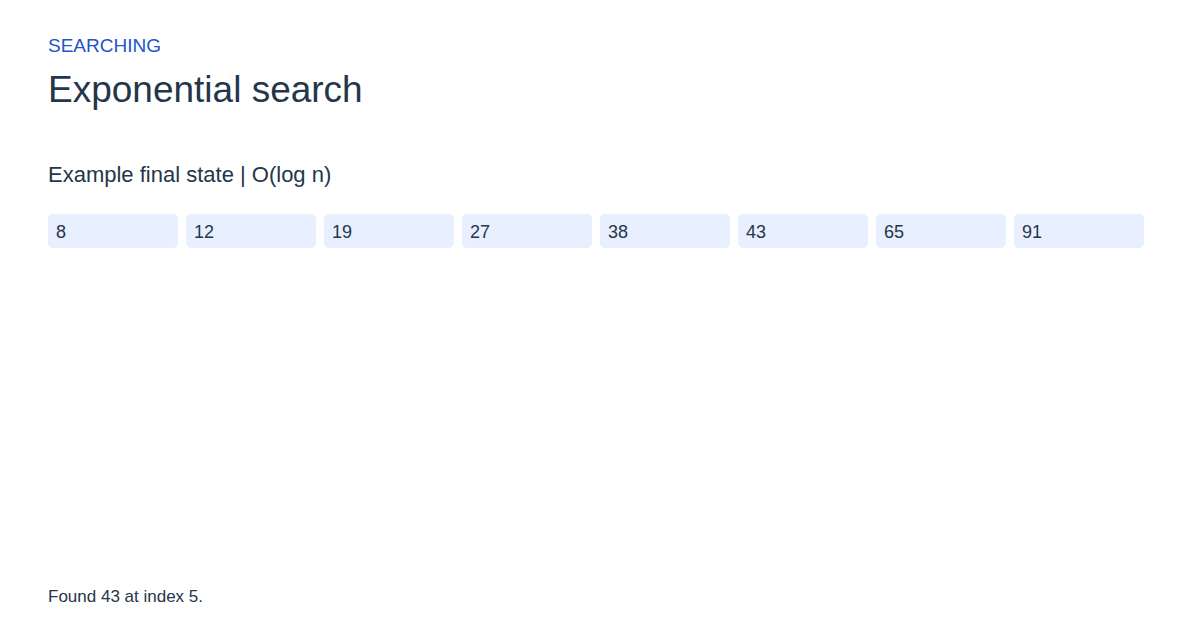
Worked example: input and state changes
Example input
38, 12, 65, 8, 43, 27, 91, 19 | 43These checkpoints follow the actual example timeline. State details show the stored values and decisions; use the visualization to inspect every intervening step.
Step 0: Initial state.
State at this checkpoint
{
  "values": [
    8,
    12,
    19,
    27,
    38,
    43,
    65,
    91
  ],
  "active": []
}
Step 1: Double range at index 1.
State at this checkpoint
{
  "values": [
    8,
    12,
    19,
    27,
    38,
    43,
    65,
    91
  ],
  "active": [
    1
  ]
}
Step 3: Double range at index 4.
State at this checkpoint
{
  "values": [
    8,
    12,
    19,
    27,
    38,
    43,
    65,
    91
  ],
  "active": [
    4
  ]
}
Step 4: Binary search in range 4–7.
State at this checkpoint
{
  "values": [
    8,
    12,
    19,
    27,
    38,
    43,
    65,
    91
  ],
  "active": [
    5
  ]
}
Step 5: Found 43 at index 5.
State at this checkpoint
{
  "values": [
    8,
    12,
    19,
    27,
    38,
    43,
    65,
    91
  ],
  "active": [
    5
  ]
}
Expected final state
Found 43 at index 5.
Complexity and input bounds
Family: Searching. Time complexity: O(log n).
Space complexity: O(1) auxiliary space.
Working-space bounds describe algorithm state and any explicitly noted output, excluding the visualization's saved timeline. Recording frames can use more memory than running the function alone. Here n is sequence length, V and E are vertex and edge counts, and other parameters refer to the named input dimensions.
2–24 comma-separated integers between 0 and 99. Follow with | target.
The playground validates these limits before starting. Downloaded functions are callable implementations, with parameter and output-buffer contracts in their comments; they do not all repeat the playground's input validation.
Common mistakes and limitations
Clamp a doubled bound before indexing and search the final interval even for a missing target.
Further reading
For background on algorithm analysis and the JavaScript function interface:
- MIT OpenCourseWare: algorithm design and analysis foundations
- MDN: JavaScript function parameters and return values
Editorial and testing approach · Browse all algorithm guides
Complete JavaScript implementation
1 2 3 4 5 6 7 8 9 10 11 12 13 14 | // Requires ascending input. Returns a found index, or -1. Reference snippets assume validated playground inputs. Fixed scratch buffers have 256 slots. Sorting variants may use a different traversal strategy than the animation. function algorithm(a, n, target) { if (n == 0) { return -1; } let bound = 1; while (bound < n && a[bound] < target) { bound *= 2; } let l = Math.floor(bound / 2); let r = bound; if (r >= n) { r = n - 1; } while (l <= r) { let mid = l + Math.floor((r - l) / 2); if (a[mid] == target) { return mid; } if (a[mid] < target) { l = mid + 1; } else { r = mid - 1; } } return -1; } |
Source
Primary research source for the algorithm or its underlying method. The playground is a bounded teaching implementation, not the publication's original program.
- An almost optimal algorithm for unbounded searching
Jon Louis Bentley; Andrew Chi-Chih Yao (1976). Research paper.