Published by Dimitris Kougioumtzis · Updated
Match the rank of each final-column character to its occurrence in the sorted first column, then follow LF links backward.
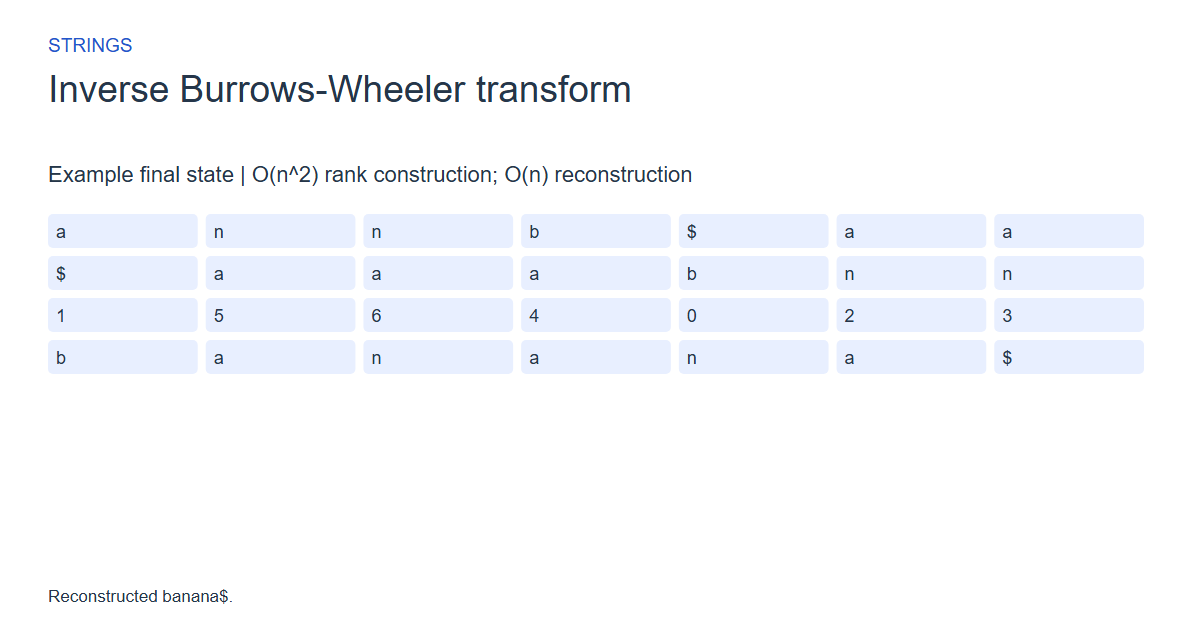
For each final-column character, count smaller characters and earlier equal occurrences to obtain its stable first-column position. Follow these LF links from the primary row, filling the original text backward.
When to use Inverse Burrows-Wheeler transform
Reversing the sentinel-based BWT without materializing the entire rotation matrix.
Choosing an alternative
The forward view sorts explicit rotations. This inverse constructs LF ranks in O(n^2) time and reconstructs the block in O(n) time.
Worked example: input and state changes
Example input
annb$aa | 4These checkpoints follow the actual example timeline. State details show the stored values and decisions; use the visualization to inspect every intervening step.
Step 0: Final column, sorted first column, LF ranks, and reconstructed text.
State at this checkpoint
{
  "values": [
    "a",
    "n",
    "n",
    "b",
    "$",
    "a",
    "a",
    "$",
    "a",
    "a",
    "a",
    "b",
    "n",
    "n",
    -1,
    -1,
    -1,
    -1,
    -1,
    -1,
    -1,
    "",
    "",
    "",
    "",
    "",
    "",
    ""
  ],
  "active": [],
  "kind": "matrix",
  "columns": 7,
  "result": 0,
  "output": []
}
Step 4: Map character b occurrence 0 to first-column row 4.
State at this checkpoint
{
  "values": [
    "a",
    "n",
    "n",
    "b",
    "$",
    "a",
    "a",
    "$",
    "a",
    "a",
    "a",
    "b",
    "n",
    "n",
    1,
    5,
    6,
    4,
    -1,
    -1,
    -1,
    "",
    "",
    "",
    "",
    "",
    "",
    ""
  ],
  "active": [
    3,
    17
  ],
  "kind": "matrix",
  "columns": 7,
  "result": 0,
  "output": []
}
Step 8: Recover position 6 and follow LF.
State at this checkpoint
{
  "values": [
    "a",
    "n",
    "n",
    "b",
    "$",
    "a",
    "a",
    "$",
    "a",
    "a",
    "a",
    "b",
    "n",
    "n",
    1,
    5,
    6,
    4,
    0,
    2,
    3,
    "",
    "",
    "",
    "",
    "",
    "",
    "$"
  ],
  "active": [
    4,
    18,
    27
  ],
  "kind": "matrix",
  "columns": 7,
  "result": 0,
  "output": []
}
Step 11: Recover position 3 and follow LF.
State at this checkpoint
{
  "values": [
    "a",
    "n",
    "n",
    "b",
    "$",
    "a",
    "a",
    "$",
    "a",
    "a",
    "a",
    "b",
    "n",
    "n",
    1,
    5,
    6,
    4,
    0,
    2,
    3,
    "",
    "",
    "",
    "a",
    "n",
    "a",
    "$"
  ],
  "active": [
    5,
    19,
    24
  ],
  "kind": "matrix",
  "columns": 7,
  "result": 0,
  "output": []
}
Step 15: Reconstructed banana$.
State at this checkpoint
{
  "values": [
    "a",
    "n",
    "n",
    "b",
    "$",
    "a",
    "a",
    "$",
    "a",
    "a",
    "a",
    "b",
    "n",
    "n",
    1,
    5,
    6,
    4,
    0,
    2,
    3,
    "b",
    "a",
    "n",
    "a",
    "n",
    "a",
    "$"
  ],
  "active": [],
  "kind": "matrix",
  "columns": 7,
  "result": 7,
  "output": [
    98,
    97,
    110,
    97,
    110,
    97,
    36
  ]
}
Expected final state
Reconstructed banana$.
Complexity and input bounds
Family: Strings. Time complexity: O(n^2) rank construction; O(n) reconstruction.
Implementation detail: Four matrix rows show last column, sorted first column, LF mapping and reconstructed text. Downloads support an empty block, return -1 on invalid input and decoded length on success. Output is unspecified on an error.
Space complexity: O(n) auxiliary ranks, visited flags and output, plus saved animation frames.
Working-space bounds describe algorithm state and any explicitly noted output, excluding the visualization's saved timeline. Recording frames can use more memory than running the function alone. Here n is sequence length, V and E are vertex and edge counts, and other parameters refer to the named input dimensions.
Final column: 1..12 lowercase letters/$ with one $ | original row (zero based). Invalid LF cycles are rejected.
The playground validates these limits before starting. Downloaded functions are callable implementations, with parameter and output-buffer contracts in their comments; they do not all repeat the playground's input validation.
Common mistakes and limitations
Equal characters must retain occurrence order. The primary row must point to the unique final-column dollar sign. Reject a cycle that revisits a row before visiting all rows.
Further reading
For background on algorithm analysis and the JavaScript function interface:
- MIT OpenCourseWare: algorithm design and analysis foundations
- MDN: JavaScript function parameters and return values
Editorial and testing approach · Browse all algorithm guides
Complete JavaScript implementation
1 2 3 4 5 6 7 8 9 10 11 12 | // Last column n 0..12, ASCII lowercase codes plus exactly one $ (36), original-row primary. Returns decoded length n or -1 for invalid alphabet, primary, sentinel count or LF cycle. Empty column accepts primary 0. Writes n codes; output is unspecified on error. Output capacity at least n. Reconstructs by stable occurrence-rank LF mapping, O(n^2) construction and O(n) reconstruction, O(n) scratch. Only the terminal-sentinel BWT convention is supported. Reference snippets assume validated playground inputs. Fixed scratch buffers have 256 slots. Sorting variants may use a different traversal strategy than the animation. function algorithm(last, n, primary, output) { if (n == 0) { if (primary == 0) { return 0; } return -1; } if (n < 0 || n > 12 || primary < 0 || primary >= n) { return -1; } let dollars = 0; let before = 0; let rank = 0; let row = primary; let lf = Array(256).fill(0); let seen = Array(256).fill(0); for (let i = 0; i < n; i++) { if (last[i] == 36) { dollars++; } else { if (last[i] < 97 || last[i] > 122) { return -1; } } } if (dollars != 1 || last[primary] != 36) { return -1; } for (let i = 0; i < n; i++) { before = 0; rank = 0; for (let j = 0; j < n; j++) { if (last[j] < last[i]) { before++; } if (j < i && last[j] == last[i]) { rank++; } } lf[i] = before+rank; } for (let i = n-1; i >= 0; i--) { if (seen[row] != 0) { return -1; } seen[row] = 1; output[i] = last[row]; row = lf[row]; } if (row != primary || output[n-1] != 36) { return -1; } return n; } |
Source
Original block-sorting research report. These views demonstrate only the reversible transform and inverse under a terminal-sentinel convention, not the complete compression pipeline described in the report.
- A Block-sorting Lossless Data Compression Algorithm
Michael Burrows; David J. Wheeler (1994). Original research report SRC 124.
